What a Buyer Would Find in Your Business Today — and What Changes.

A buyer walking through your business today would see a company that stops when you leave. That is what shows up in due diligence, and it is what drives the offer down. What changes when Litefirm builds the systems is the routing. Documented processes handle what can be documented. Automations handle what can be automated. Decisions get made at the right level. A team handles what it is trained to handle. That is what "transferable" looks like in due diligence.

The sections below are the mechanism. Each one is grounded in a specific, visible artifact — a scored diagnostic, a classification framework, a project plan, and a before-and-after of the work itself.

The Engagement, in Brief

Five-step Litefirm engagement path: free diagnostic, project plan, build period, Acquirer Feedback Review, sale through Synergy Business Brokers.

The engagement from first assessment to sale.

The engagement from first assessment to sale.

Everything below this point is the detail of these five steps — what each one produces, and what it looks like inside a business.

What the work looks like

The examples on this page come from two places: the systems Litefirm built and operates inside its own M&A advisory business, and an illustrative client engagement used to show the methodology applied. The distinction is marked where it matters. The work itself looks like this.

Owner-handled staff escalations converted into a documented routing layer. In Litefirm's own operation, routine escalations to the founder dropped from roughly 25 a week to 5.

Inbound customer inquiries routed through an AI-assisted response workflow — drafts built from a documented FAQ and response guide, reviewed by staff before sending, escalated only by exception.

Invoice generation triggered automatically from job-completion entries, with anomalies flagged for human review before anything goes out.

A weekly operating schedule generated from the business's own data and reviewed by the owner for awareness — no longer built by him from memory.

Client-facing authority and scheduling responsibility distributed across managers and staff, so operational knowledge stops concentrating in one or two people.

The first thing the diagnostic produces is a clear picture of where the business depends on you today — scored across five dimensions, graded for buyer impact, and ranked by what would change most.

The Exit Preparation Diagnostic

Every engagement begins with the Exit Preparation Diagnostic — the structured opinion of an M&A advisor with more than fifteen years of experience selling businesses like yours. It assesses where the business depends on you personally, grades how that dependency would affect a buyer's offer, and produces a ranked backlog of the specific projects that would change what a buyer finds. Most owners complete the intake in 20 to 30 minutes. The report is delivered within 24 hours, free.

Preparing a business for a clean exit takes one to four years of active work, and most owners underestimate the timeline. The most impactful changes — the ones that move the independence score and affect deal terms — typically require 90 days of focused implementation before they show up in the business's operations in a way a buyer's representative would recognize. The diagnostic tells you where the first 90 days go.
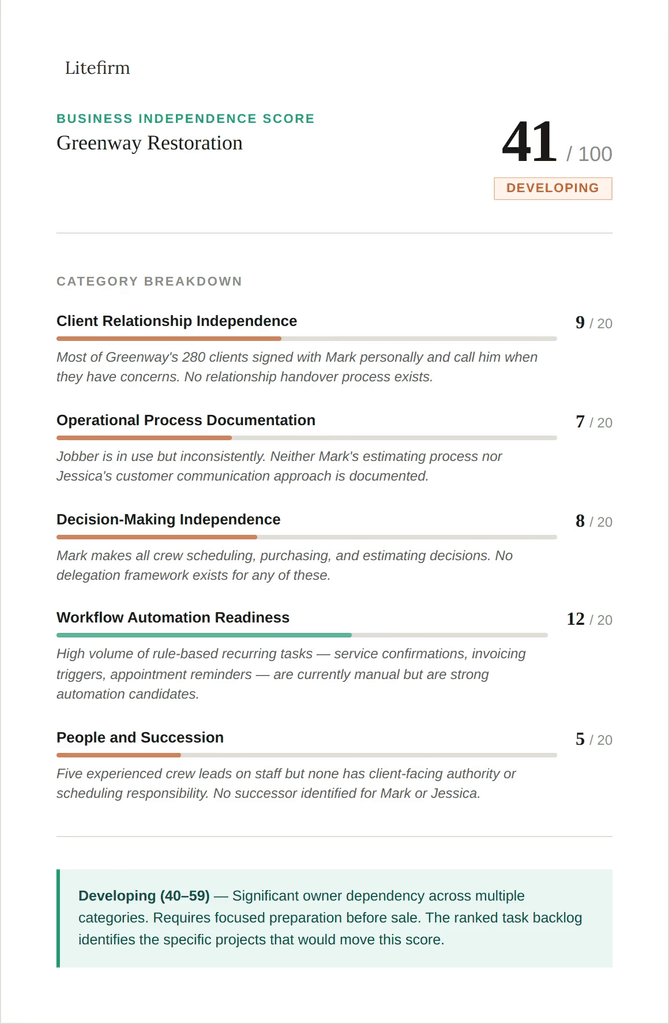
Illustrative Litefirm Business Independence Score diagnostic output for a fictional business showing a score of 41 out of 100 across five categories — client relationships, process documentation, decision-making, automation readiness, and succession — used to identify owner dependency before exit preparation.

Each category score is annotated with the finding that drove it.

Each category score is annotated with the finding that drove it.

The full description of the diagnostic — everything it produces, and a complete sample report — is on the diagnostic page.

Who Is Able to Buy It

The argument for reducing owner dependency is usually made in terms of price. There is a prior argument, and it is more absolute. When a business falls within the SBA's size limits — as most owner-led businesses do — its most likely individual buyers finance the purchase with a 7(a) loan, and those loans carry rules about what the seller may do after closing.

When a buyer acquires the whole business, the seller is required to divest completely. He cannot remain an officer, director, shareholder, or employee. Since October 2023 the only permitted post-closing role is consulting as an independent contractor, for a period the SBA holds to twelve months including extensions, with no authority over operations and no continuing share of profits.

The structure that used to allow longer involvement was retained equity — the seller keeps a minority stake and stays on.Under the rules effective June 2025, a seller who retains equity must personally guarantee the buyer's entire SBA loan for at least two years. Few sellers accept that, which has made the arrangement commercially impractical.

The consequence for an owner-dependent business is direct. The lender is not assessing what discount to apply. It is assessing whether the loan gets repaid once the person the business depends on is required to leave. A business that cannot demonstrate it runs without him is frequently not financeable, which means it is not saleable to the buyers who dominate this market. Buyers who do not need financing exist. There are fewer of them, and fewer buyers means less competition on terms and on price.

Above the program's size limits the capital changes — conventional acquisition lenders, search funds, private equity — and the published rulebook disappears. The question does not. Every financing partner has to judge whether the business runs without its seller, and answers it by paying less, delaying part of the payment, requiring the seller to stay on, or walking away.

Source: SBA SOP 50 10 8, effective June 1, 2025, and SBA 7(a) change-of-ownership requirements.

The diagnostic tells you where the business stands.
What follows is the analytical work that tells us where to build.

The diagnostic tells you where the business stands. What follows is the analytical work that tells us where to build.

The Framework: How We Map What You Do

What follows describes how Litefirm analyzes a business once an engagement begins. This is not the Exit Preparation Diagnostic (the 20-to-30-minute intake and 24-hour report described above). It is the deeper analytical work that happens once a client has engaged Litefirm to do the preparation work.

Part 1 — Everything the Owner Does

The framework begins by mapping the full scope of what the owner does — not only the work visible in email, but the decisions made in conversations, on calls, and in the moments when customers and staff interrupt the day. Work reaches the owner through four channels, each recovered differently:

Diagnostic channels framework

Litefirm exit preparation diagnostic channel framework showing four methods for identifying owner-dependent work: email archive analysis, connected software logs, screen activity sampling, and structured debriefing, with fidelity ratings and timing for each channel. Channel How we analyse it What it surfaces Fidelity Email Reactive requests, correspondence Archive analysis ~1,000 emails processed. Programmatic categorization. Only channel where trigger and response are both visible. Projects surface weeks 1–2. Work categories Type classification Volume data Project candidates High weeks 1–2 Connected software CRM, ops platforms, invoicing, calendar, PM tools Export and log analysis Activity logs exported where available. Calendar reviewed. Actions visible; triggers inferred. Months 1–2. Work patterns Commitments Review workflows Automation targets Med months 1–2 Other screen-based Tools without logs; ad hoc computer work Activity sampling (1–2 wks) Owner logs what they were doing at random intervals. More reliable than unaided recall. Months 2–4. Tasks not in logs Habitual work Effort estimates Later-phase projects Lower months 2–4 Off-computer work Phone calls, decisions, verbal approvals Structured debriefing Litefirm leads short weekly conversations: walk us through decisions only you could make. Iterative over months. Key decisions Verbal approvals Relationship topics Documentation topics Guided ongoing All four channels feed the same output: a ranked project list, each item classified and assigned. Higher-fidelity channels produce projects earlier. Lower-fidelity channels fill in the picture over time. The diagnostic is not a single event — it runs continuously for the life of the engagement.

Email is the highest-fidelity channel, because both the trigger and the response are preserved. An inbox audit categorizes every recurring message and shows how many require the owner directly.

Inbox audit workflow

Litefirm inbox audit diagram from the exit preparation diagnostic showing five email categories with monthly volume and the owner-dependent work each category generates. Knowledge system Context system Filter Category Volume Owner involvement Project type Client status inquiries "Where does my project stand?" — requires case data 312 High Context Vendor and supplier coordination Approvals, pricing decisions, relationship management 187 Medium Context Staff questions and escalations "Can you approve this?" / "What should I do about…" 241 High Context New business inquiries Qualifying questions, pricing, intake — pattern responses 134 Medium Know. Administrative and low-signal Invoices, receipts, newsletters, notifications 126 Low

Recurring Task Types Found in Email

Litefirm exit preparation project type diagram showing two implementation paths, knowledge system and context system, with three-stage build arcs for each type of owner-dependent task identified in the diagnostic. What does this email require? The answer determines the project type Knowledge system Same answer regardless of who asks Context system Answer depends on the specific case What it takes Archive indexed and searchable System drafts · human reviews before sending Examples from this inbox New business inquiries Qualifying questions, pricing, intake Other common knowledge cases General FAQs, policy questions, intake forms Email history: full archive needed for building the knowledge base How it gets built — three stages 1 · Historical training We study how you responded to past cases — what context you drew on and how it shaped your answer 2 · Supervised operation System handles new cases. A human — your staff or Litefirm-managed — decides whether to send the response or flag the case for your review 3 · Reduced dependency As the system handles more cases correctly, fewer are escalated to you. Your role becomes the exception. Examples from this inbox Client status · vendor coordination · staff escalations ~1,000 emails for initial analysis Case database is the ongoing input

Part 2 — Project Definition

What follows are frameworks for organizing, defining, and selecting projects to execute.

What follows are frameworks for organizing, defining, and selecting projects to execute.

Task classification framework

Litefirm task classification framework diagram showing a two-stage decision flow, whether a task can be delegated and whether it is knowledge-based or context-based, used to categorize owner-dependent work for exit preparation implementation. Discovered task From any channel · any fidelity level Can this be delegated? Physical-presence work: delegate to an existing employee or local hire. Remote work: delegate to an existing employee or Litefirm-managed contractor. Non-delegable Owner only Documented, not a project Knowledge or context? Knowledge: stored patterns + task content. No case lookup needed. Context: same inputs, plus stored information about this specific case. Knowledge system Knowledge base + task content No case lookup needed Context system Knowledge base + task content + case database lookup Who handles it? Specified in the project plan. Most tasks use a combination. Owner Exceptions only goal: this shrinks Employees Existing team Remote or on-site Contractors via Litefirm platform Remote · auto-tasked and managed AI Autonomous for simple, low-stakes tasks; draft + review for the rest

Remote work is routed to employees, to Litefirm-managed contractors, or to AI, with the mix set in the project plan. The contractors are the resource Litefirm uniquely provides: remote, auto-tasked, and managed by the platform.

Escalation and resolution system

Litefirm resolution system diagram showing the standing routing architecture built during exit preparation, four input channels routed to owner, knowledge system, or context system paths, reducing owner involvement to only decisions that genuinely require it. Work reaches the owner through multiple channels Email Text messaging Operations platforms Project management tools Routing layer Categorizes every incoming item · trained on your history · improves over time A standing system — every future item passes through this, permanently Needs owner Knowledge system Context system Owner responds High-judgment only. Litefirm flags and briefs. goal: this shrinks Knowledge system Archive lookup · draft generated · human reviews before sending goal: this grows Context system Case database · team member or contractor handles or flags goal: this grows Handled. Documented. Improved. Owner time protected. System gets smarter.

Project candidates list

Litefirm exit preparation project candidates table showing five ranked implementation projects identified from inbox analysis, with project type, estimated owner hours per month, complexity rating, and a ranking formula based on owner time value and implementation complexity. How projects are ranked Rating = (owner hrs/month × hourly cost + incremental profit upside) ÷ complexity Profit upside included only when the owner has a clear view of it. Otherwise the formula uses hours × cost alone. # Project Type Hrs / month Complexity 1 Staff escalation routing Context ~24 hrs 2 of 3 Decision framework and case database for common escalation types 2 Client status response system Context ~18 hrs 2 of 3 Case database lookup · AI draft generated · human reviews before sending 3 Inbox routing layer Prereq. ~6 hrs 1 of 3 Prerequisite for projects 1 and 2 · categorize and route all inbound items first 4 New business inquiry flow Know. ~10 hrs 1 of 3 Archive indexed · qualifying questions and follow-up sequence automated 5 Admin filtering and auto-routing Filter ~4 hrs 1 of 3 Remove low-signal email from the owner's view — rules-based, no database Project 3 must be built before projects 1 and 2 Each project gets a written plan — scope, timeline, your time requirement, testing procedure, and rollback steps — before any work begins. You approve the plan. Work starts only after you do. The inbox is one source of projects. Operations platforms, text messages, and off-computer work surface the rest. Together they build the picture of where the business depends on you.

The Project Plan

The ranked list becomes a project plan: scope, timeline, testing steps, and owner approval checkpoints for every initiative, built before any work begins and updated as the engagement runs. The owner approves the direction and receives monthly reporting on what was built and what it cost.
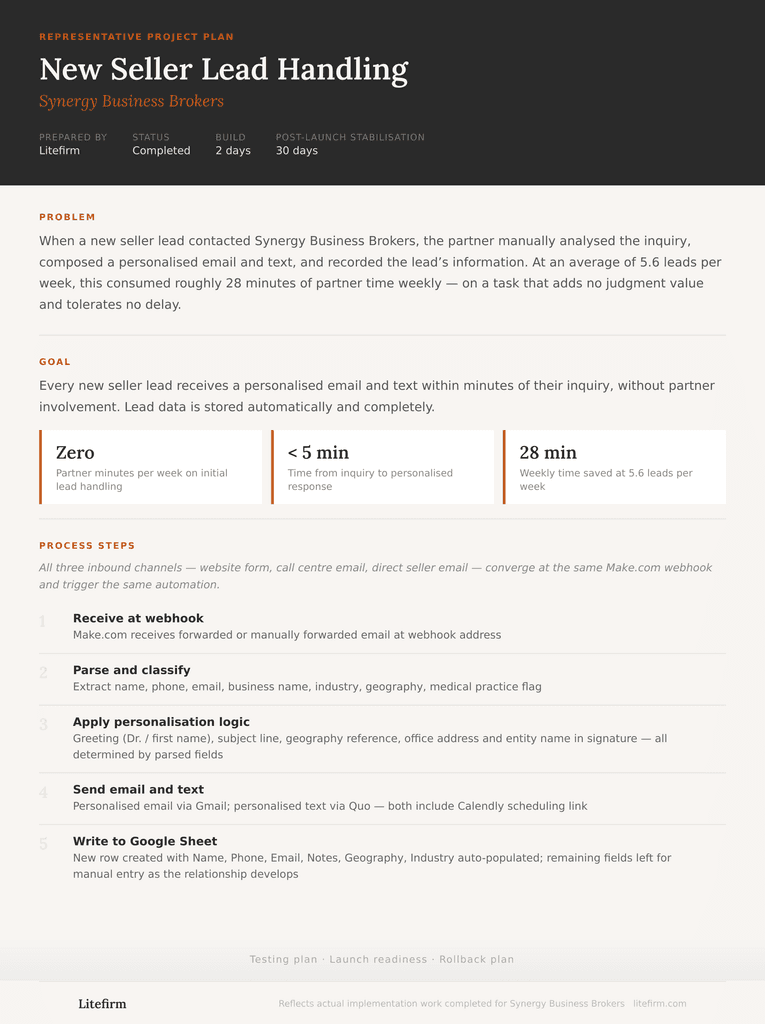
This is an illustrative example of a Litefirm project plan.

Litefirm project plan for an operational system implementation completed for Synergy Business Brokers, showing problem statement, measurable goals (28 minutes saved per week), and a five-step automation process for new seller lead handling.

The Acquirer Feedback Review

Six months into the engagement, something happens that no exit planning firm, coaching practice, automation agency, or fractional operator can offer: an Acquirer Feedback Review.

Litefirm approaches one to three real, qualified potential acquirers — sourced from Synergy’s active buyer network, selected to match the profile of buyer most likely to purchase your specific business. After signing a non-disclosure agreement and receiving a current valuation reference point, these acquirers assess the business with one question in front of them: what do they see, and what would make it more valuable to them?

The conversation is relationship-first. Acquirers participate because they are serious buyers who want early access to businesses that may come to market. The feedback they provide is candid.

Within 48 to 72 hours, the Litefirm team delivers a written debrief organized into three categories: gaps that the implementation work can address directly during the preparation period; decisions that are yours to make; and characteristics of the business that will not change before the sale — which inform how it will be positioned and priced at listing, without surprise.

A second review may be offered at Litefirm's discretion, depending on engagement progress and the time remaining before listing.

Taking part in the Acquirer Feedback Review does not commit you to selling through Synergy. It is part of preparing the business, not a brokerage agreement, and the decision of who takes it to market is yours to make when the time comes.

Before any of this ran in a client's business, it ran in ours.

The M&A Proof

The methodology on this page was built and run inside Litefirm's own M&A advisory operation before it was offered to a single client. That operation, Ashish's M&A practice at Synergy, had the exact problem this page describes: too much ran through one person, and it slowed the business down.

The channel mapping, the task classification, and the escalation structure you have just read about were built there first, as operational requirements rather than experiments. The routine items that pulled the founder into daily triage dropped from roughly 25 a week to 5. The 5 that remain are the situations that genuinely require senior judgment. The time the systems gave back is the time those decisions now get — applied by the people the deals depend on.

What follows is not a diagram of a concept. It is a description and screenshots of a system that is operating.

Before-and-after comparison of M&A business workflow — left showing the manual owner-dependent process before Litefirm implementation, right showing the automated systematized process after, illustrating how owner involvement is reduced through exit preparation.

INBOUND ACTIVITY → STRUCTURED WORKFLOW

Make.com workflow architecture for the automated buyer response system built for Litefirm's M&A advisory business — multi-branch automation handling buyer inquiry routing, AI-drafted personalized responses, and Google Sheets tracking.

Make.com automation workflows built for Litefirm's M&A advisory business.

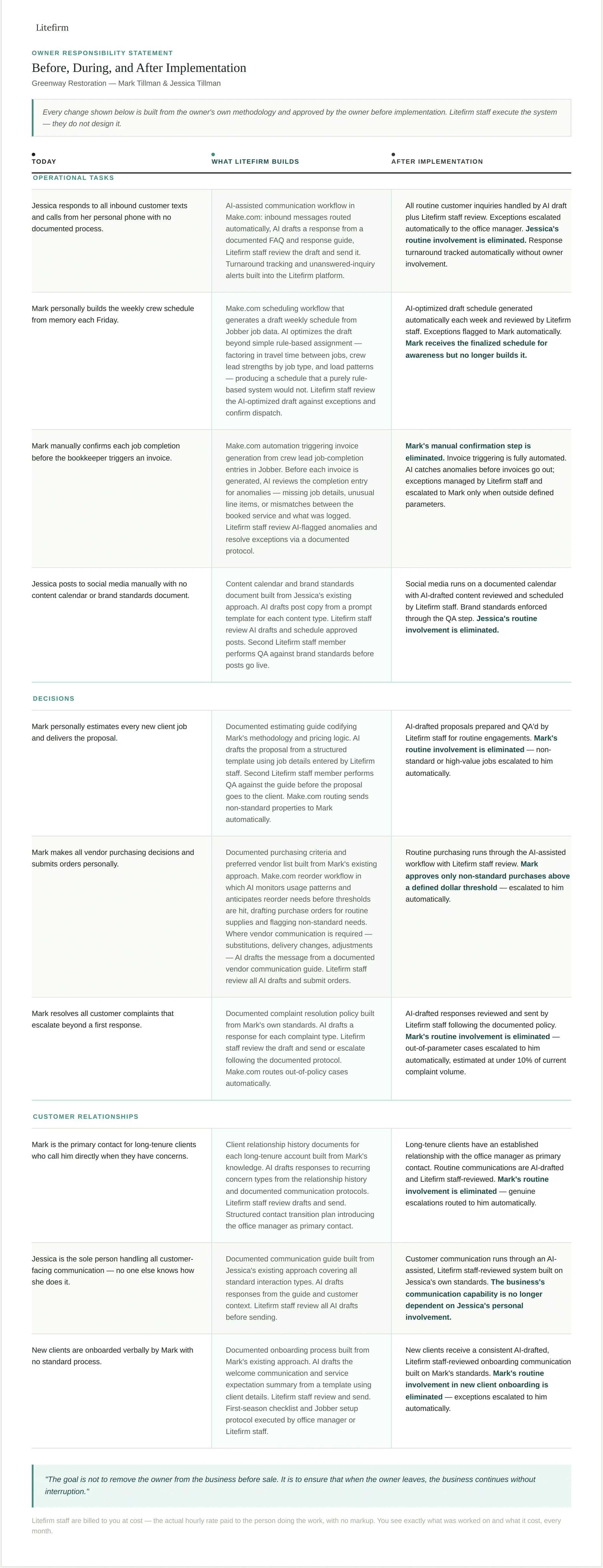
Owner Responsibility Statement

Every Litefirm engagement produces an Owner Responsibility Statement — a structured map of what the owner currently does and what changes when the work is complete. It is what a buyer’s due diligence team would find if they examined the business at the start of the engagement and again at the end.

Buyers assess key-person risk throughout the organization, not only at the owner level. The statement captures this at every layer — owner, managers, key staff, technical specialists. By the time a buyer’s due diligence team walks through, what they find is operations that do not concentrate in any individual.

Litefirm Owner Responsibility Statement showing what a buyer sees in a business before and after exit preparation — owner dependency documented and addressed.

The M&A work shows the methodology in one business. The Owner Responsibility Statement will show what the methodology finds in your business.

What It Sells For

Across fifteen years of brokerage and M&A advisory work, the pattern is consistent: an owner-dependent business that should have sold for three and a half times its annual earnings sells for two and a half. The discount is the difference between what a buyer is willing to pay for a business that runs through one person and what they will pay for the same business when it runs through documented systems and a trained team.

2.93x → 4.49x

2.93x → 4.49x

Value Builder System reports an average exit multiple of 2.93x for typical small businesses versus 4.49x for businesses scored high on transferability, a 53% gap.

Source: Value Builder System, published exit-readiness study. Methodology directional; figures vary by industry and deal size.

Value Builder System reports an average exit multiple of 2.93x for typical small businesses versus 4.49x for businesses scored high on transferability, a 53% gap.

Source: Value Builder System, published exit-readiness study. Methodology directional; figures vary by industry and deal size.

10–25% discount

10–25% discount

William Buck and Brady Ware both report key-person discounts in the 10% to 25% range, applied during due diligence when a single individual's departure would materially affect business performance.

Source: William Buck Business Valuation Guide; Brady Ware key-person risk analysis. Both note the discount is applied during deal structuring, not at listing.

William Buck and Brady Ware both report key-person discounts in the 10% to 25% range, applied during due diligence when a single individual's departure would materially affect business performance.

Source: William Buck Business Valuation Guide; Brady Ware key-person risk analysis. Both note the discount is applied during deal structuring, not at listing.

95%+ of mid-market businesses

95%+ of mid-market businesses

Class VI Partners finds that more than 95% of mid-market businesses show some degree of owner dependency that affects valuation during sale.

Source: Class VI Partners M&A practice analysis. The figure addresses prevalence, not severity; severity varies materially by business.

Class VI Partners finds that more than 95% of mid-market businesses show some degree of owner dependency that affects valuation during sale.

Source: Class VI Partners M&A practice analysis. The figure addresses prevalence, not severity; severity varies materially by business.

Here is what due diligence finds in an owner-dependent business: inconsistent process documentation, revenue or relationships that exit when the owner exits, and an operating model built around the seller's specific knowledge and relationships rather than documented systems a new owner could step into. Each of these translates to a discount.

The work described on this page begins with the diagnostic — a specific, scored assessment of where the business depends on you and which projects would change that most.